
Marlene Dietrich stood out as one of the most legendary sex symbols of the 1930s. Her breakthrough role came with The Blue Angel (1930), where she mesmerized audiences as the seductive cabaret performer Lola Lola. After the success of that film, she made the move to Hollywood, cementing her place as a star during the early years of sound cinema. Throughout her career, she worked alongside some of the era’s most celebrated leading men, including Cary Grant, Gary Cooper, and Jimmy Stewart. With her platinum hair, smoldering eyes, and distinct German accent, Dietrich became the very image of the glamorous European femme fatale.
Publicity photo of Marlene Dietrich for the film Shanghai Express (1932)

Yet despite her reputation as a silver screen siren, Marlene Dietrich’s advice to young people during a 1969 interview with Jay Kent Hackleman was strikingly down-to-earth and wise — almost grandmotherly in tone. Though she was one of the most captivating beauties of her time, Dietrich made it clear she navigated Hollywood with integrity. She firmly stated, “I have never used my body.” She acknowledged that her body had been showcased in roles, but emphasized, “I’ve never done that in real life.”
She also offered a warning about fame and admiration: “You can’t succumb to adoration because people adore so many things,” she said. “They also adore things you might find useless. So you shouldn’t take admiration too seriously.”
When it came to the concept of relaxation, Dietrich shared a unique European perspective. “You see, there is no such word as ‘relax’ in German or in French,” she explained. “It’s purely an American idea.” She noted how, in America, people often feel they must “relax” at a set time — like taking a drink at 7 p.m. — while in Europe, drinking was simply something people did for enjoyment, not necessity. Dietrich suggested that the American obsession with success created an unhealthy cycle. Many believed that success would guarantee happiness, but she argued they were not the same at all.

In essence, Dietrich hinted that when you love the work you do, you don’t need to “relax” from it. It’s only when stuck in an unfulfilling grind that the need for escape arises.
Marlene Dietrich with a bouquet of flowers, 1962
One of her most profound reflections was about money and possessions. Although Dietrich accumulated considerable wealth during her lifetime, she was critical of America’s disposable consumer culture. “In Europe, if they have a car, they keep it for 15 years. They polish it, wash it, and cherish it. But here, people don’t love their cars because they know they’ll get a new one next year,” she observed. In her view, Americans bought much more than they needed, often on credit, mistaking possessions for happiness — a happiness that, ultimately, eluded them.
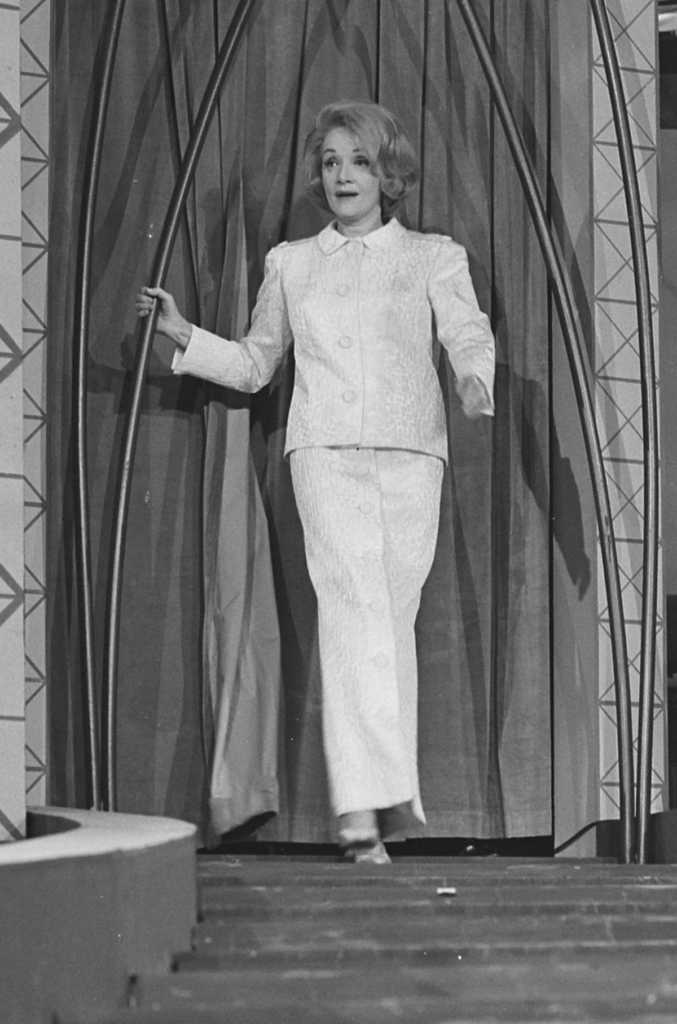
Marlene Dietrich in 1963
When asked if growing older bothered her, Dietrich gave a simple, wise reply: “I think irreversible things you cannot begrudge — if you have any bit of intelligence.”
Her reflections — drawn from a lifetime spent traveling the world, enduring two World Wars, and living a dazzling yet challenging career — sound much like the timeless wisdom many of us heard from our own grandmothers.
Marlene Dietrich in 1953, postcard for the Sahara in Las Vegas

Indeed, Dietrich, who became a grandmother herself at 47, seemed to have gathered a wealth of life lessons long before many thought to ask for them. Lessons like “money can’t buy happiness” and “grow old gracefully” — insights that, decades later, still resonate.